
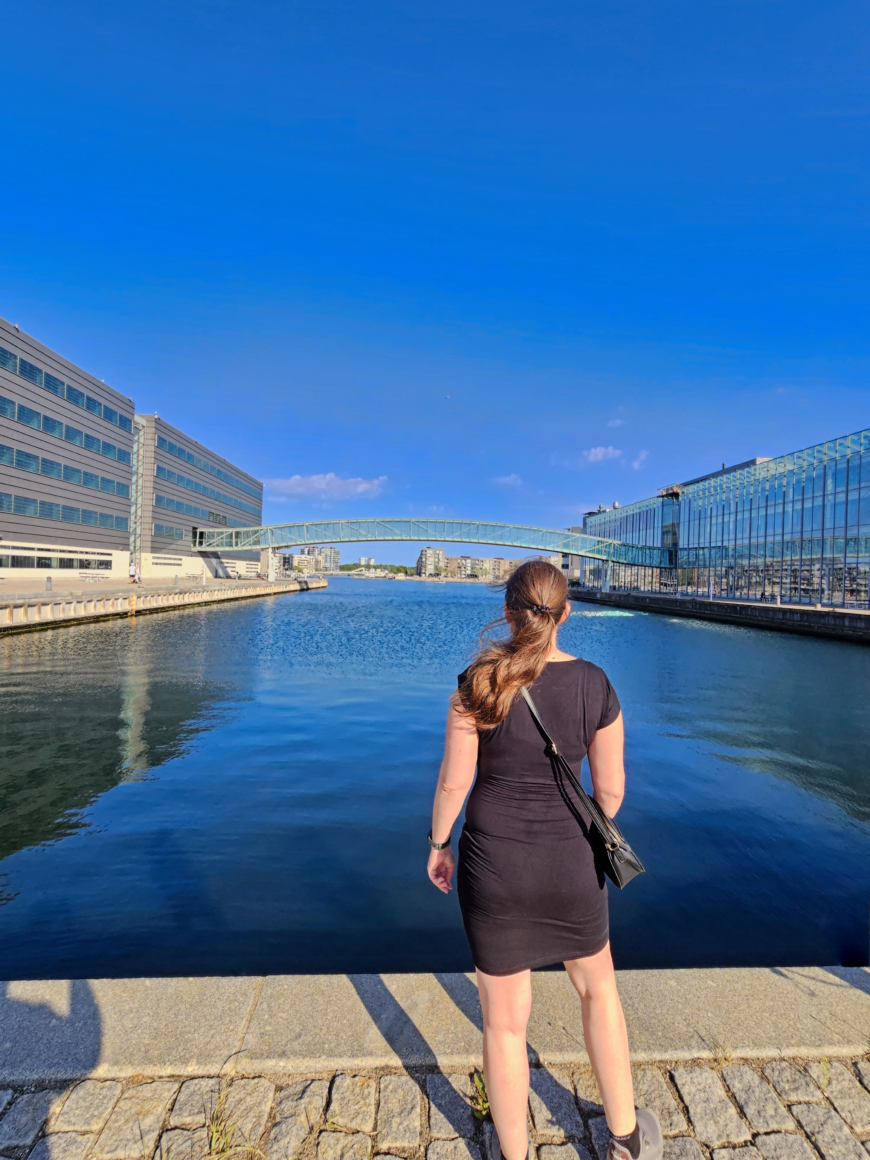
On moving to Denmark, rebuilding my career, and learning what job search can do to your sense of self.
We arrived in Denmark with five suitcases, two one-way tickets, and thirty years of life packed up between us, which sounds almost organised until you are standing in an airport queue for four hours, watching your carefully planned relocation start falling apart before you have even left the country.
Our move didn’t begin with celebration or certainty. It began with a cancelled flight, a long queue, and the panic of standing next to our suitcases while people around us said there might not be another plane for four or five days. My husband was meant to start his new job in Denmark the next morning, so we booked another flight with another airline and went home for the night.
The next day was April 1st, and we flew to Copenhagen on April Fool’s Day, which, in hindsight, felt about right.
People often ask me why Denmark, usually before they ask how much Danish I speak. The honest answer is that it was a mixture of timing, intuition, and one LinkedIn message that could easily have been ignored. My husband had been contacted by recruiters before and usually did not reply, but one day I encouraged him to answer. A few interview rounds later, he had a job offer, and the shape of our life changed.
His company allowed him to work from their Budapest office for a while so we could prepare properly, which gave me time to say goodbye to my own managerial role in Hungary and start imagining what I would do in Denmark.
I was hopeful, and probably also a little naïve. I had experience, I had worked as a manager, I had recruited people myself, and I had been on the hiring side of the table, so I thought that would count for something.
And it did, although not as quickly or in the way I expected.
The first months
When we arrived, I started Danish lessons almost immediately and joined the Spouse Programme at International House. I tried to do all the “right” things: learn the language, understand the system, go to events, meet people, update my CV, and apply for jobs.
I also tried to enjoy the beginning. I walked around Copenhagen, learned to bike — although I still find Danish cyclists mildly terrifying — and gave myself permission to be new.
But starting over in a new country is rarely just one story.
That summer, while my husband was travelling for work, I received a message that my childhood friend had died of an overdose. She was thirty-four.
I was alone in Copenhagen when I found out. Later, her mother asked me to speak at the funeral, so I flew back to Hungary, said a few words, and returned to Denmark carrying something I hadn’t left with.
Grief has a way of relocating with you. It doesn’t need a visa.
That was one of the first things I learned about moving countries: you don’t arrive as a clean, fresh version of yourself. You arrive with your history, your losses, your fears, your hopes, your family, and your unfinished stories.
And then, somehow, you are expected to write a strong CV and “sell yourself” in a labour market that does not yet know what to do with you.
Applying into silence
I started applying for jobs, first casually, then seriously, and eventually with the kind of quiet desperation you don’t really want to admit to.
I had experience from Hungary, but in Denmark I quickly realised that experience does not always translate automatically. Titles are different, expectations are different, networks matter, cultural codes matter, and as an international, you often need to explain not only what you have done, but why it is relevant here.
That sounds simple when it is written as career advice, but it is not simple when your confidence is already being worn down by rejection.
I sent dozens of applications, got a few interviews, and made it through some processes. Sometimes I received a polite rejection, and often I received nothing at all.
The silence was one of the hardest parts, because when you apply for jobs in a new country, you are not only waiting for an answer about a role. You are also waiting, in some quiet and slightly unreasonable way, for an answer about yourself.
You start wondering whether you are employable here, whether your experience counts, whether someone will understand what you can do, and whether you made a mistake moving in the first place.
While I was trying to find my way, I took an unpaid photography internship. Photography had been part of my life for years, and the internship gave me a reason to leave the apartment with purpose. I photographed Copenhagen Carnival, Pride, and smaller events across the Nordics.
It didn’t pay anything, but it reminded me that I could still contribute, still create something, and still have a place somewhere.
That matters more than people think, because long-term job search is not only a practical challenge. It is an identity challenge.
You go from being someone with a role, a title, colleagues, routines, and recognised professional value to being someone at home, refreshing emails, rewriting cover letters, and trying not to take silence personally.
But of course it feels personal.
When life interrupts the job search
Then my father was hospitalised.
The message from Hungary was serious. Life-threatening, they said. I booked a flight for the next morning, and before boarding I called the hospital to ask how he was, but they would not tell me anything because they could not verify my identity over the phone.
So I got on the plane with one question in my head for the whole flight: would he still be alive when we landed?
He survived. He spent a month in hospital and came home alive, but that period took something from me. I stayed in Hungary for almost two months, helping my family, being present, and trying to hold everything together.
When I came back to Copenhagen, I was not the same person who had left, and my job search was still waiting for me.
This is another part of international life that rarely fits neatly into career advice. People tell you to network, tailor your CV, learn Danish, be proactive — and of course, all of that matters. But life does not pause just because you are trying to find a job. You may be grieving, worrying about family in another country, feeling left behind while your partner settles into work, or slowly losing sight of the person you used to be before the move.
The practical advice is necessary, but it was never the whole picture for me.
The final rounds that didn’t become jobs
After the internship ended, I went back to applying, and another long stretch followed with more applications, more waiting, more interviews, and more near-misses.
At one point, I was in the final round for a role at a large, well-known company, and around the same time, I was also in the final round for a startup. Either would have been a relief, not only because I needed a job, but because I needed proof that I had not become invisible.
The large company pulled the role because of budget cuts, and the startup offered me the job.
I said yes, even though it was not exactly what I had done before, because I wanted to work, earn money, have colleagues, and stop being the one at home.
I wanted my professional life back.
But the role was not the right fit. The company struggled to bring in customers, my tasks became unclear, and I slowly felt more and more out of place. My manager was kind and patient, but I often felt like I was not fully myself in that office. My English felt smaller than it did in my head, the culture was new, the expectations were unclear, and my confidence was already fragile.
Eventually, they let me go.
I negotiated a part-time handover role to help with the office relocation, mostly so I could stay on the payroll a few weeks longer. I remember sitting at a desk while other people worked and laughed around me, not completely sure what I was meant to be doing, feeling like a burden with a badge.
When the office move was done, I said goodbye. It was March 2020.
Rock bottom
That spring, I hit my lowest point professionally.
My husband’s career was moving forward, while mine had gone backwards.
Financially, we were okay, but emotionally I was not okay with the dependency. I had worked hard for my independence. I had been a manager, built things, made decisions, and carried responsibility, and now I felt like I had become smaller.
Not because my skills had disappeared, but because I had lost the context where they were recognised.
That is something many internationals know very well. You may have a career behind you. You may have led teams, managed projects, handled complex stakeholders, built systems, solved problems, hired people, trained people, and supported people.
Then you move countries, and suddenly you feel like you are starting from zero, not because you are zero, but because the market does not yet understand your story.
And sometimes, if the job search goes on long enough, you start to forget it too.
I made a deal with myself. I would give it one more serious try and apply in Denmark and in Hungary, and whichever door opened first, I would walk through.
I wanted to stay in Copenhagen, because against the odds of the previous two years, it had started to feel like home. But I could not keep going like that.
Then COVID arrived, and suddenly borders closed, moving became impossible, staying felt impossible too, and I had no job, no direction, and no clear way to change countries either.
The call that changed everything
A few weeks later, I was somehow back in the same strange situation: two final rounds.
One was a Department Manager role at a large Swedish company, and the other was a Team Manager role in Hungary.
I completed the final interview for the Hungarian role and waited, but then the role was withdrawn because of COVID.
Another door closed again.
Then my phone rang.
The Swedish company was offering me the job, pending a background check.
I was overjoyed, and then immediately anxious. The background check involved multiple countries and took longer than expected, and after two years of almost-there, I had learned not to trust good news too quickly.
In the middle of the process, my future manager called. During the check, they had found an old photography project of mine online, something creative from an earlier chapter of my life that I had almost forgotten was still there.
There was nothing wrong with it, but it was a vulnerable moment, and a reminder that when you apply for jobs, especially in a new country, you sometimes feel like every part of you is being inspected.
We talked about it honestly, and they decided to go ahead.
I don’t think I will ever forget that call.
After two years of applications, rejections, silence, final rounds, cancelled roles, and slowly losing trust in myself, someone said yes. It was not a rescue, just a yes, but it felt like ground under my feet.
From job seeker to hiring manager in Denmark
That job became a turning point, not because everything suddenly became easy, but because I slowly stepped back into a professional identity I recognized.
I became a manager again. I recruited people, interviewed candidates, read CVs from the other side of the table, and made hiring decisions. Later, in other roles, I continued working with recruitment, onboarding, people development, international employees, and career transitions, and over time I started to understand the Danish job market from both sides.
I knew what it felt like to be the international candidate trying to explain your value in a new country, while also wondering whether your experience would be understood at all.
But I also saw what it looked like from the hiring side, when a CV was unclear, when a profile sounded too broad, when a candidate undersold themselves, or when strong experience was hidden behind wording that did not quite fit the Danish context.
That combination changed something for me, because I began to realise that many internationals do not lack skills, experience, or potential. More often, what is missing is translation — not only language translation, although that can also matter, but the kind of translation that helps an employer understand where your experience fits, what you bring, and why it is relevant here.
People often need help making their career story clearer without making it smaller. They need to understand what Danish employers are listening for, what to highlight, what to leave out, and how to explain transitions, gaps, international experience, broad backgrounds, or non-linear careers in a way that feels honest and grounded.
They need practical tools, of course, but they also need someone who understands what the process can do to your confidence.
I did not know then that this experience would later become part of the work I do today.
At the time, it was just my life: two years of uncertainty, grief, applications, silence, near-misses, practical lessons, and finally one yes that changed the ground beneath me.
I carry both sides of that story with me now: the person who applied into silence, and the person who later read applications from the other side of the table.